How many shares should you buy? Comparing five position sizing models.
Two traders can take the exact same setup — same stock, same entry, same stop — and end up with completely different outcomes. The difference usually isn't the idea. It's how much of it they bought.
Most trading education focuses on finding stocks, reading charts, and timing entries. Position sizing — deciding how many shares to buy — gets a single sentence, if that.
That's backwards. An entry can be a little early or late and the trade still works. Size it wrong, and one bad trade undoes weeks of good ones. Position sizing is the bridge between conviction in an idea and actually preserving your capital if that idea is wrong.
That's the real job of any risk-aware trade decision engine: not picking the stock for you, but turning your risk limits and conviction into a share count you can defend — the same way, on every symbol, every time.
The example trade
One setup, used throughout this article, so the numbers stay comparable:
| Portfolio capital | €100,000 |
| Entry price | €205 |
| Stop-loss | €188 |
| Take-profit | €236 |
| Risk per share (205 − 188) | €17 |
| Reward per share (236 − 205) | €31 |
| Risk / Reward | 1 : 1.82 |
Same setup, five sizing models, five very different positions. Krino computes all five side by side, every time:
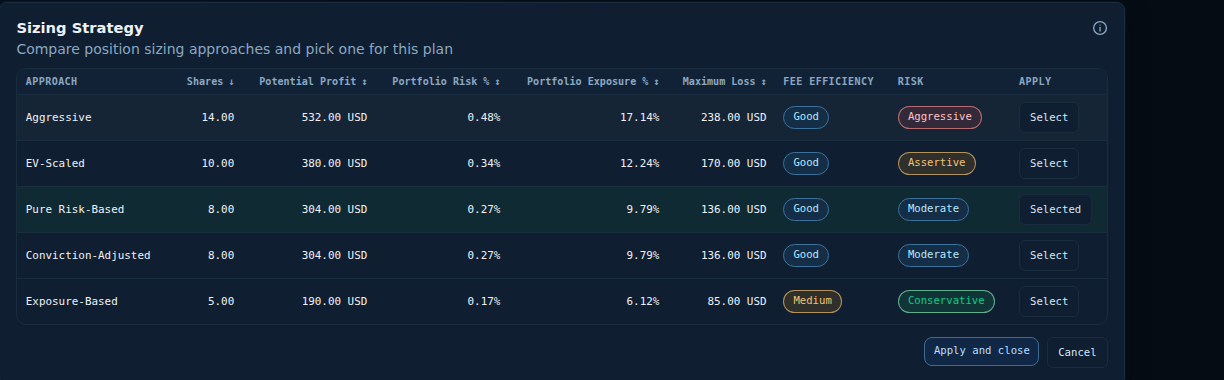
Here's each one, formula first.
1Pure Risk-Based Sizing
Decide in advance how much money you're willing to lose. Size the position so a full stop-out costs exactly that — nothing more.
| Allocated capital (this symbol) | €40,000 |
| Risk % | 1.2% |
| Risk amount = 40,000 × 1.2% | €480 |
| Shares = 480 / 17 | ≈ 28 |
| Position value | ≈ €5,740 |
| Maximum loss | ≈ €476 |
| Potential profit | ≈ €868 |
- Strong discipline
- Excellent capital preservation
- Same dollar risk on every trade
- Can produce very small positions
- Feels restrictive on high-conviction ideas
This is why most professional risk desks start here: the position is built backward from what you can afford to lose, not forward from how much you want to own. It's the Pure Risk-Based row in the screenshot above.
Pure Risk-Based sizing answers "how much can I afford to lose" first, and lets share count fall out of that — not the other way around.
2Conviction-Adjusted Sizing
Krino's default. Starts from the same risk cap as Pure Risk-Based, then shrinks it by how strongly your own rules agree with each other on this setup.
Where "conviction" actually comes from
Every indicator you've configured — RSI, MACD, an EMA/SMA crossover, Bollinger Bands, whatever's weighted in your rule set — votes toward Buy or Sell, each with its own weight. Conviction is just the margin between the two sides, as a share of the total weight in play:
Every rule pointing the same direction pushes conviction toward 1.0. A near-even split between conflicting signals pushes it toward 0. This is also the same number used as Krino's entry gate — fall short of your configured Min Conviction to Trade and the plan never gets built in the first place. So by the time a Buy signal reaches sizing, conviction has already cleared that bar, and Krino re-scales it before using it: 0 right at the gate, 1 at maximal agreement.
Size Fraction always lands between 0.5× and 1.0× — it can only shrink the Pure Risk-Based quantity, never grow it past that ceiling.
| Pure Risk-Based shares | 28 |
| Raw conviction (rule agreement) | 0.82 |
| Your min conviction to trade | 0.40 |
| Normalized = (0.82 − 0.40) / (1 − 0.40) | 0.70 |
| Size fraction = 0.5 + (0.5 × 0.70) | 0.85 |
| Shares = floor(28 × 0.85) | 23 |
| Position value | ≈ €4,715 |
| Maximum loss | ≈ €391 |
| Potential profit | ≈ €713 |
- Sizes down automatically when your own rules disagree with each other
- Never exceeds the Pure Risk-Based ceiling
- Only as good as the rules and weights you configured
- Two setups with identical risk can size differently
It's why the Conviction-Adjusted row in the screenshot above sometimes matches Pure Risk-Based exactly (conviction near the ceiling) and sometimes sits well below it.
Conviction-Adjusted sizing is a discount, not a boost — it trims the risk-based quantity down when your own rules only barely agree, it never sizes you up beyond what pure risk already allows.
3Exposure-Based Sizing
Instead of starting from the stop-loss, start from how much of your total portfolio this idea deserves.
| Exposure % | 10% |
| Target position = 100,000 × 10% | €10,000 |
| Shares = 10,000 / 205 | ≈ 48 |
| Maximum loss | ≈ €816 |
| Potential profit | ≈ €1,488 |
- Simple and intuitive
- Produces more meaningful position sizes
- Dollar risk varies trade to trade
- A wide stop quietly means a bigger bet
It's the most conservative row in the screenshot above — the smallest share count of the five, since it never lets the stop distance justify a bigger position.
Exposure-Based sizing caps how big a bet gets in portfolio terms — but two trades at the same exposure % can carry very different dollar risk if their stops sit at different distances.
4EV-Scaled Sizing
Not every setup deserves the same size. A conviction multiplier scales the position up or down based on how strong the setup actually is — this is a real Krino setting, not a metaphor:
| Low conviction | 0.5× |
| Normal | 1.0× |
| Strong | 1.5× |
| Exceptional | 2.0× |
Applied to our Exposure-Based baseline of 48 shares, on a Strong setup:
| Base position (Exposure-Based) | 48 shares |
| Strong setup: 48 × 1.5 | 72 shares |
| Maximum loss | ≈ €1,224 |
| Potential profit | ≈ €2,232 |
- Aligns capital with your best ideas
- Rewards a genuine edge
- Only works if conviction is scored consistently
- Can become subjective without a fixed rule
That's the EV-Scaled row in the screenshot above — larger than Exposure-Based, smaller than Aggressive.
EV-Scaled sizing only helps if "strong setup" means the same thing every time you use it — otherwise it's conviction-based sizing wearing a formula's clothes.
5Aggressive Sizing
Some traders deliberately concentrate capital in their highest-conviction ideas, accepting a much larger swing in exchange for a much larger payoff if right.
| Max exposure | 30% of portfolio |
| Position value = 100,000 × 30% | €30,000 |
| Shares = 30,000 / 205 | ≈ 146 |
| Maximum loss | ≈ €2,482 |
| Potential profit | ≈ €4,526 |
- Meaningful upside when you're right
- A handful of winners can carry a whole portfolio
- Drawdowns can be severe
- Requires real emotional discipline to hold through
It's the largest row in the screenshot above, and the only one flagged with an Aggressive risk badge.
Aggressive sizing isn't wrong — but it's a deliberate, bounded exception, not a default. Know your ceiling before you approach it.
All five, side by side
Same entry, same stop, same take-profit. Only the share count changes — and with it, everything downstream.
| Approach | Shares | Position Value | Maximum Loss | Potential Profit | Portfolio Risk % | Risk / Reward |
|---|---|---|---|---|---|---|
| Pure Risk-Based | 28 | €5,740 | €476 | €868 | 0.48% | 1.82 |
| Conviction-Adjusted Default | 23 | €4,715 | €391 | €713 | 0.39% | 1.82 |
| Exposure-Based | 48 | €9,840 | €816 | €1,488 | 0.82% | 1.82 |
| EV-Scaled Strong | 72 | €14,760 | €1,224 | €2,232 | 1.22% | 1.82 |
| Aggressive | 146 | €29,930 | €2,482 | €4,526 | 2.48% | 1.82 |
Notice the Risk/Reward ratio never changes — sizing doesn't touch entry, stop, or target. It only changes how much of that same ratio you're exposed to. The same pattern holds in the screenshot above: Exposure-Based smallest, Aggressive largest, the other three in between.
- Pure Risk-Based — new to systematic trading, or rebuilding discipline after a rough stretch.
- Conviction-Adjusted — want Krino's default: risk-capped sizing that also discounts for a weak or thin edge.
- Exposure-Based — want simple, consistent position sizes across a watchlist.
- EV-Scaled — have a track record and want capital to follow conviction, deliberately.
- Aggressive — concentrated, high-conviction investing with a stomach for drawdowns.
Common mistakes
- Sizing on emotion — buying more because a stock "feels" right, not because a rule said so.
- Sizing on conviction alone — skipping the risk math because you're "sure" about this one.
- Ignoring stop distance — the same share count means very different risk depending on how far the stop is.
- One size for every trade — treating a high-conviction setup and a speculative punt identically.
- Positions too small to matter — sizing so conservatively that fees and slippage eat the edge.
A framework, not a formula
No single number makes a trade safe. Three things have to work together:
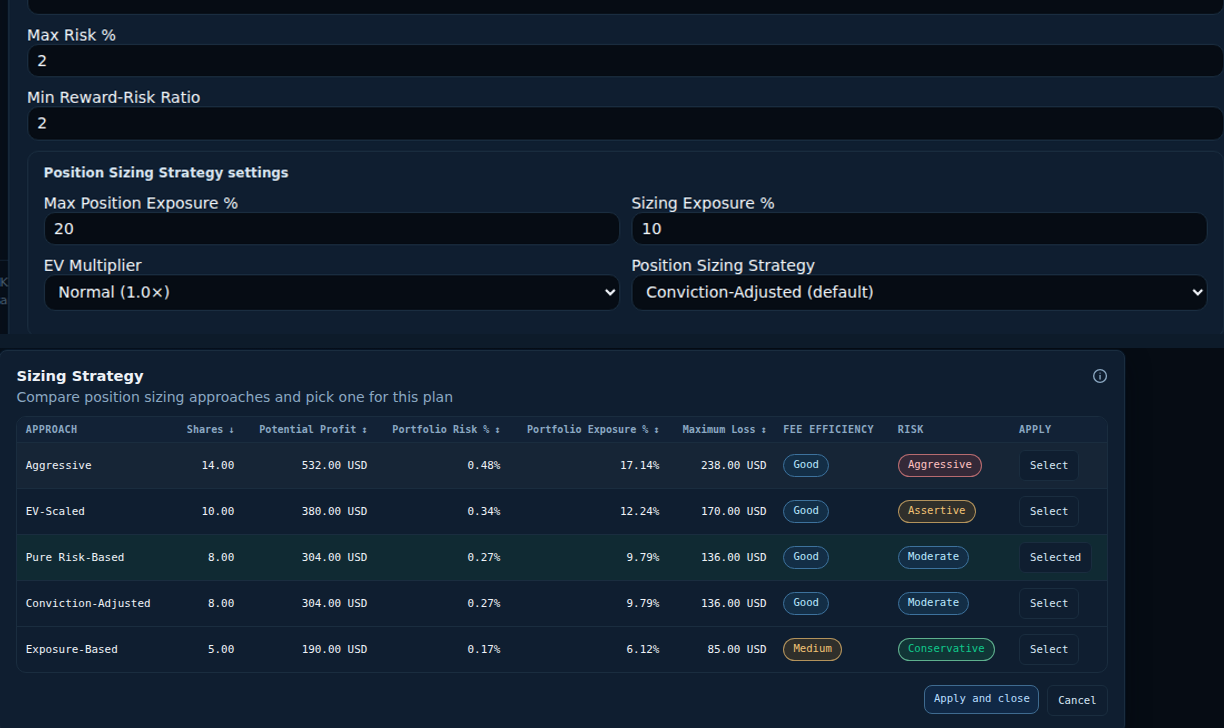
| Maximum exposure | How big any one symbol can get, portfolio-wide. |
| Maximum risk | How much you're willing to lose if the stop is hit. |
| Sizing model | The formula that turns those limits into a share count. |
Change one without the others and the whole plan drifts — a generous exposure cap paired with a careless risk % still produces a careless trade.
How Krino helps
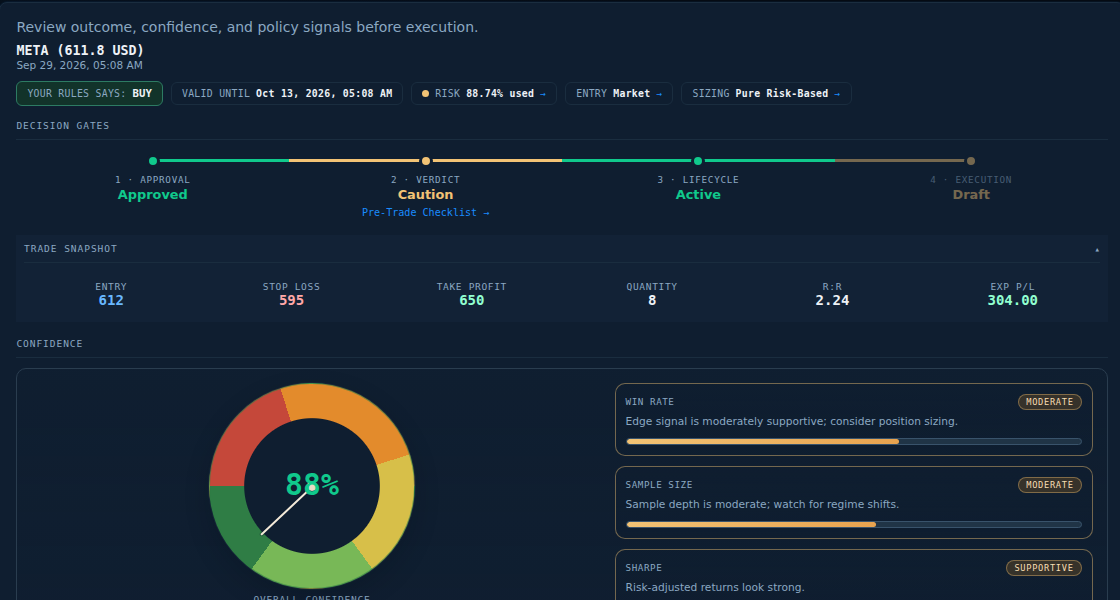
Everything above is arithmetic anyone can do by hand — Krino just does it automatically, every time, so the comparison is in front of you instead of assumed:
- Compares all five sizing models side by side for the same trade
- Checks the resulting risk against your account and per-symbol budget before you can act
- Shows fee efficiency and a risk classification for every approach, not just the one you picked
- Turns the whole thing into one structured, timestamped trade plan you can revisit later
None of it replaces judgment about which stock to trade. It just makes sure the size of the bet was actually decided, not guessed.
The question that actually matters
Not "is this a good stock?" That question has no risk in it.
The better question: "How much should I buy if I'm wrong?"
Good trading is selection, risk definition, and position sizing, applied consistently. Before your next trade, size it on paper first — in Krino or otherwise — and see which model you'd actually be comfortable holding through a loss.
Krino executes rules and risk limits you configure. It is not personalized investment advice, and its operator is not a licensed or regulated financial advisor. Trading involves risk of loss. You are solely responsible for your own trading decisions. The worked example in this article uses illustrative figures; screenshots show Krino's demo mode with different, unrelated numbers.