How AI can improve trading decisions, and where it shouldn't.
AI is good at reading, summarising and spotting patterns in your own records. It is a poor place to outsource accountability. A practical split between the jobs you can hand over and the decisions you should keep.
Every trader is now told that AI will improve their results. Some of that is true; much of it just feels productive.
This article is not for or against AI. It sorts the jobs. Some tasks reward speed, memory and pattern-matching. Others depend on accountability, consistency and a fixed rule you can point to when things go wrong.
The problem: confident answers without accountability
Ask a general-purpose AI whether to buy a stock and you will get a fluent paragraph. It will not know your risk budget, your open positions or your rules. It cannot be held to yesterday’s answer, because tomorrow’s may differ.
Fluency feels like competence, but you end up risking real money on an answer nobody can reproduce or audit.
Key concept: AI as analyst, rules as the decision
A workable split: let AI help you prepare and review and let fixed rules decide and limit.
| Good for AI | Summarising news and filings, tidying notes, finding patterns across your journal, drafting a plan for you to check |
| Keep as rules | Position size, stop placement, risk limits, entry and exit conditions, go or no-go |
If a decision can cost you money, it should be reproducible: same inputs, same answer, written down. Use AI to get better inputs and better reviews, not to replace the rule.
Worked example: one trader, three uses
- Review: the trader exports a quarter of journal entries and asks an assistant to find recurring patterns. It notices that most of the largest losses followed a stop being widened. That is a pattern a human would take weeks to see, and it points at a rule to tighten.
- Preparation: before the open, the assistant summarises overnight news on three watchlist names. The trader reads it as context, not as a signal.
- Decision: the trade itself is sized and gated by fixed rules: risk per trade, stop distance, budget left. No assistant is involved at that step.
- Outcome: speed where speed helps, accountability where it counts, and an audit trail that does not depend on a chat history.
Comparison: where each tool fits
| Job | Rules engine | AI assistant |
|---|---|---|
| Size a position | Yes: deterministic, auditable | No: may vary, cannot see your budget |
| Enforce a risk limit | Yes | No |
| Summarise news or filings | Poor fit | Good, verify key facts |
| Find patterns in your journal | Limited to what you defined | Good at surfacing candidates to test |
| Draft a plan to review | Yes, from your rules | Possible, still needs checking against rules |
| Explain a decision afterwards | Yes, from the actual inputs | May sound plausible without being the real reason |
Common mistakes
- Treating a fluent answer as an analysis. Ask what data it used. If it cannot say, ignore it.
- Letting it set size or stop. These are your risk limits. They belong in rules you control.
- Testing on the data it was shown. A pattern found in a journal must be checked on trades it has not seen.
- Skipping the audit trail. If you cannot reproduce why you traded, you cannot learn from it.
- Outsourcing the discipline. A tool that tells you what you want to hear is not a risk manager.
A framework you can use tomorrow
- Write the rules first. Risk per trade, stop logic, size, minimum reward-to-risk.
- Use AI upstream. Summaries, context and idea generation. Treat them as input.
- Let rules decide. Same inputs, same verdict, recorded.
- Use AI downstream. Review journals, find recurring mistakes, propose rule changes.
- Test every proposed change on past data before it becomes a rule.
How Krino helps
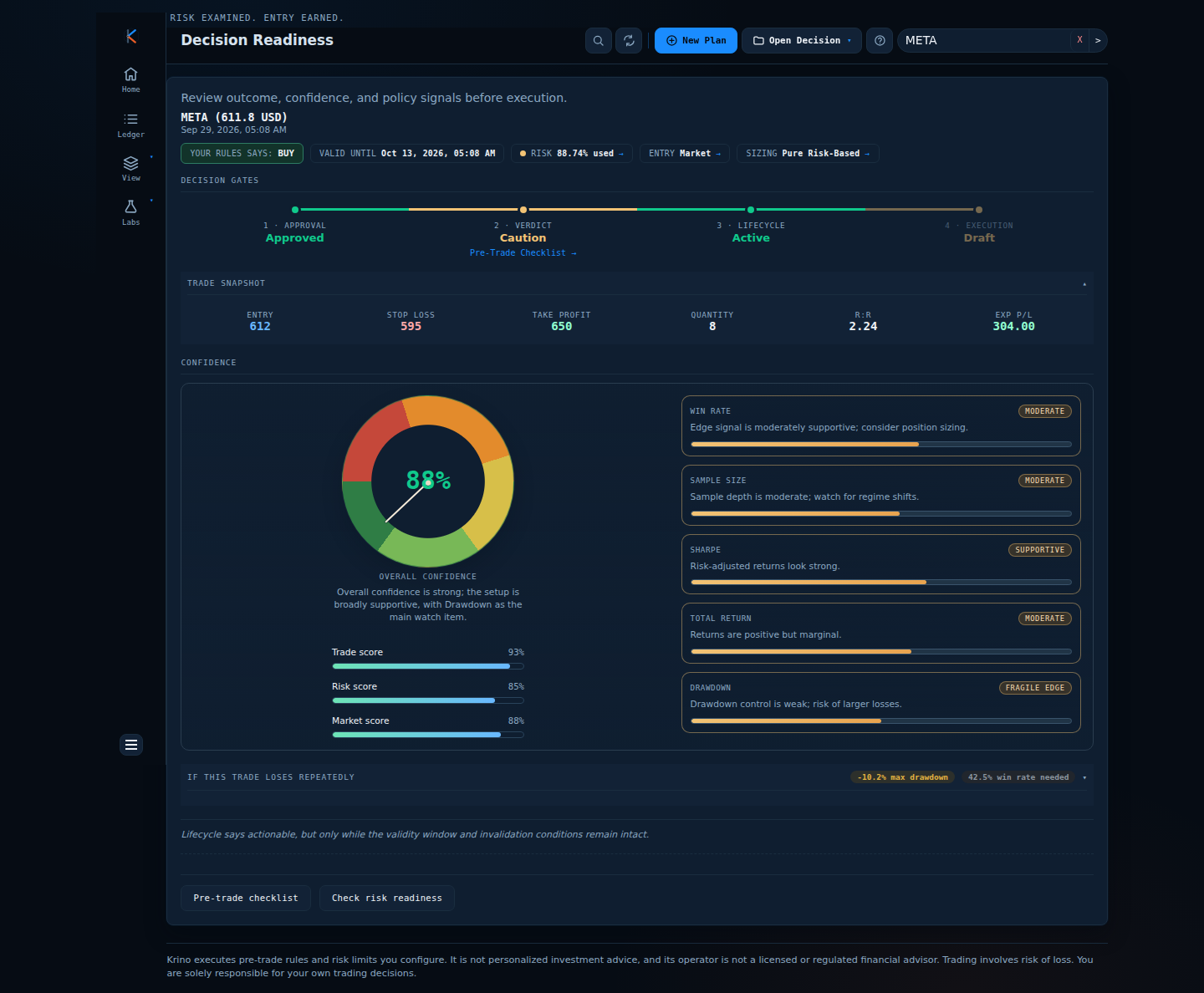
Krino is the rules-and-record half of that split. You configure the rules (risk limits, minimum reward-to-risk, sizing model, indicator weights) and it applies them the same way every time, so a decision can be reproduced from its inputs. Each decision is saved with its reasons, confidence factors and plan levels.
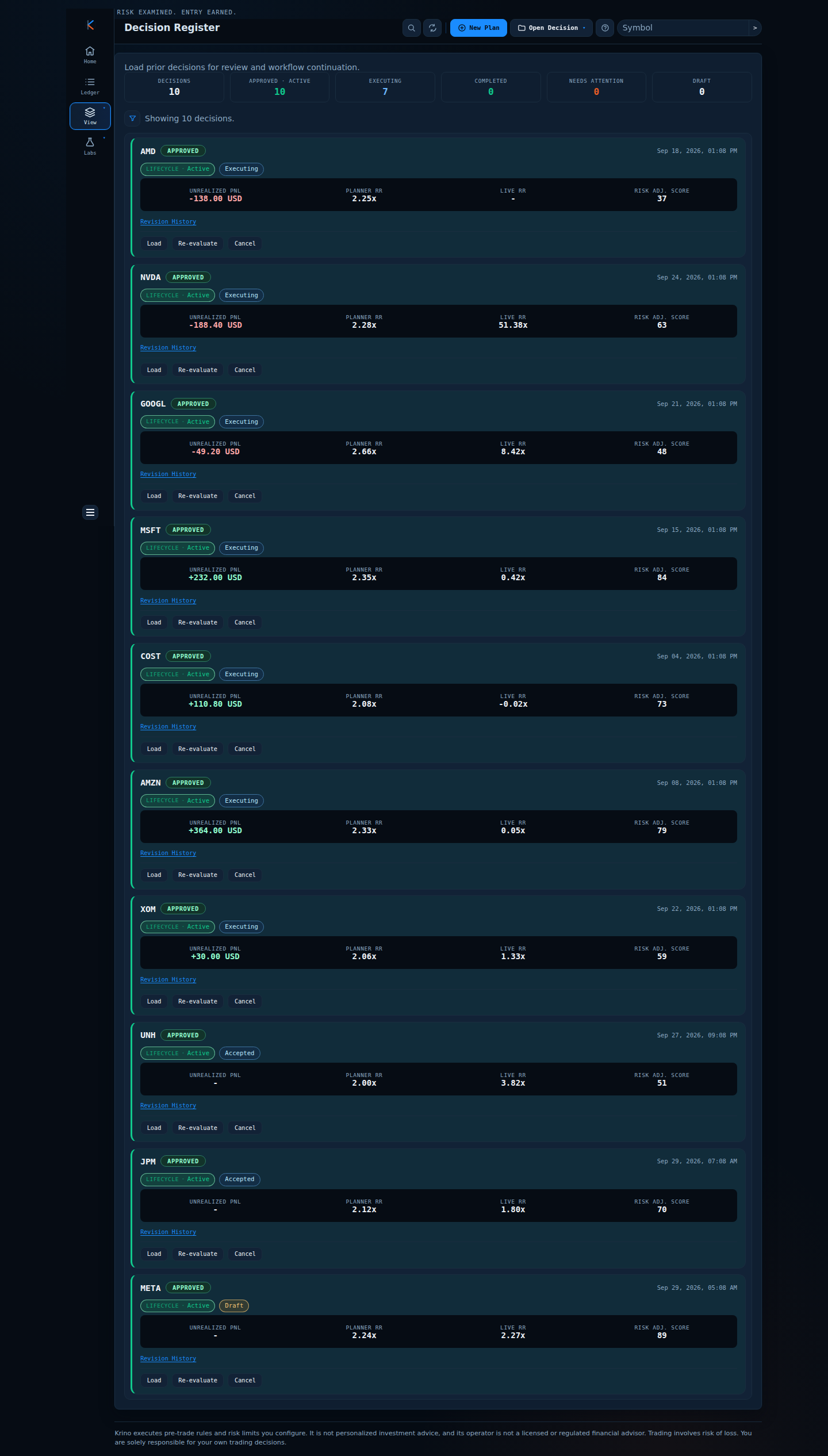
That record is also what makes downstream review possible: the register, execution journal and compare views hold the facts, and what-if tools let you test a proposed change before it becomes a rule. It does not replace your judgment about which ideas to pursue.
Check the reasons behind a real plan.
The demo opens a META plan: verdict, entry, stop, size and the confidence drivers behind each number. No signup, no email, no card.
Quick start checklist
- Write your risk, size and stop rules before using any assistant.
- Use AI for summaries and journal patterns, not for go or no-go.
- Ask what data any AI answer used, and verify key facts.
- Record the inputs and outcome of every decision.
- Test any AI-suggested rule on data it has not seen.
- Keep the final gate deterministic.
The question that actually matters
Instead of asking “can AI tell me what to buy?” ask “which part of my process is slow, and which part must be reproducible?” Use AI for the first, rules for the second, and write down which is which.
Plan your next trade with your rules doing the deciding.
Use the analysis, keep the decision in your rules. The demo runs in your browser, no signup needed.
Krino executes rules and risk limits you configure. It is not personalized investment advice. Trading involves risk of loss. You are solely responsible for your own trading decisions. The worked examples in this article use illustrative prices and demo data, not a recommendation or real market data.