Signal ranking explained: picking the best setup from a long list.
Fifteen symbols on the watchlist, capital for three. A good ranking sorts ideas by quality after risk, not by how exciting they look.
A watchlist lists what you might do, not what to do first. When ten setups look decent and your budget covers three, the order is a decision, and most traders make it by instinct.
Ranking makes that decision explicit. This article shows how to rank setups so the top of the list is the best use of limited capital, and how to read a ranking critically.
The problem: the loudest signal wins
Traders rank by what is most exciting: the biggest move, the strongest indicator reading, the most talked-about ticker. A strong signal can still be a poor trade if the stop is far, the reward thin or the history fragile.
Ranking on one number is the mistake. Quality needs at least two: how strong is the signal and how well does the trade hold up under risk.
Key concept: score the signal, then score it after risk
Give each setup two scores:
| Signal score | How strongly your technical rules agree |
| Risk score | How well the trade holds up on risk and history |
| Risk-adjusted score | The average of the two, 0–100 |
Sort by risk-adjusted score first, then signal score, then expected reward-to-risk. A great signal with a weak risk profile slides down instead of leading.
Rank by what survives risk. A top signal that fails on risk should not outrank a good signal with a clean risk profile.
Worked example: reading a ranked list
| Symbol | Type | Risk-adj. | Signal | Planned R:R | Entry | Stop | Target |
|---|---|---|---|---|---|---|---|
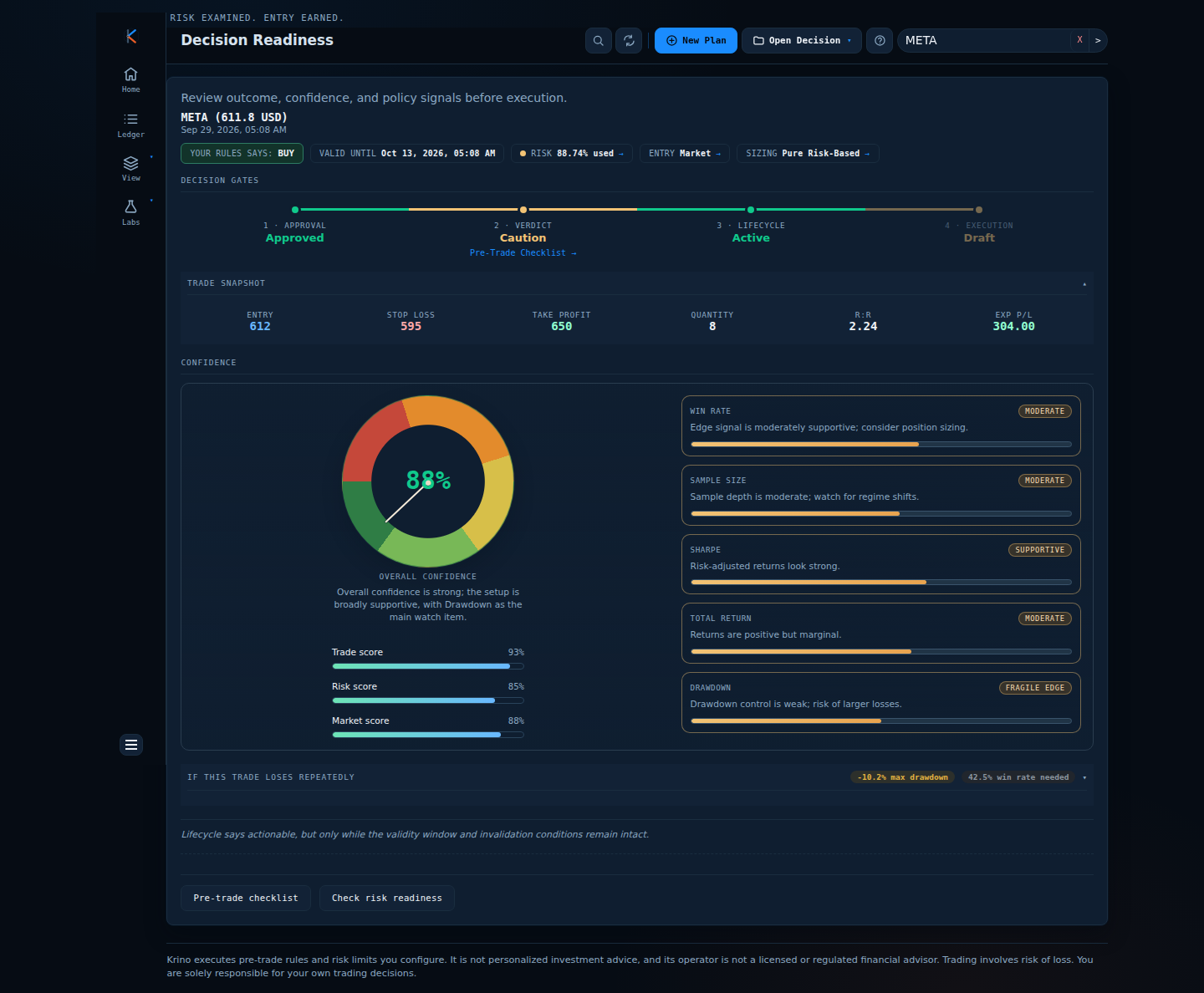
| META | Breakout | 89 | 93 | 2.2 | 612 | 595 | 650 |
| CAT | Breakout | 68 | 72 | 2.1 | 389.2 | 372 | 425 |
| BA | Short | 61 | 65 | 2.5 | 176.5 | 184 | 158 |
| QQQ | Trend | 55 | 59 | 1.9 | 486 | 472 | 512 |
| AAPL | Breakout | 41 | 45 | 2.1 | 188 | 178.5 | 208 |
- Situation: five candidates, budget for roughly two.
- Decision: META leads on both scores. BA has the best reward-to-risk (2.5) but a lower score, so it is a smaller, second choice. AAPL, at 41, is a candidate to wait on.
- Outcome: you act on the top of the list, and you have a stated reason for leaving the bottom of it alone.
Comparison: ways to rank a watchlist
| Method | Strength | Weakness |
|---|---|---|
| Biggest move today | Easy to see | Rewards what already happened |
| Signal strength only | Rule-based | Ignores stop distance and history |
| Reward-to-risk only | Simple, risk-aware | A wide target can inflate it |
| Risk-adjusted score + tie-breakers | Quality after risk, stable ordering | Only as good as the underlying rules |
Common mistakes
- Ranking on a single number. Use at least a quality score and a risk view.
- Ranking positions you already hold with new ideas. They answer different questions. Rank candidates separately from open trades.
- Chasing rank without checking budget. A top-ranked idea can still be blocked by a symbol or account limit.
- Not recording why you skipped the second one. Skipped ideas are data for later.
A framework you can use tomorrow
- Build one list of candidate setups only, with no open trades.
- For each, record a signal score, a risk view and planned reward-to-risk.
- Sort by the risk-adjusted score, then signal score, then reward-to-risk.
- Take only as many as your risk budget allows from the top.
- Write one sentence for why the next one down is not a go.
How Krino helps
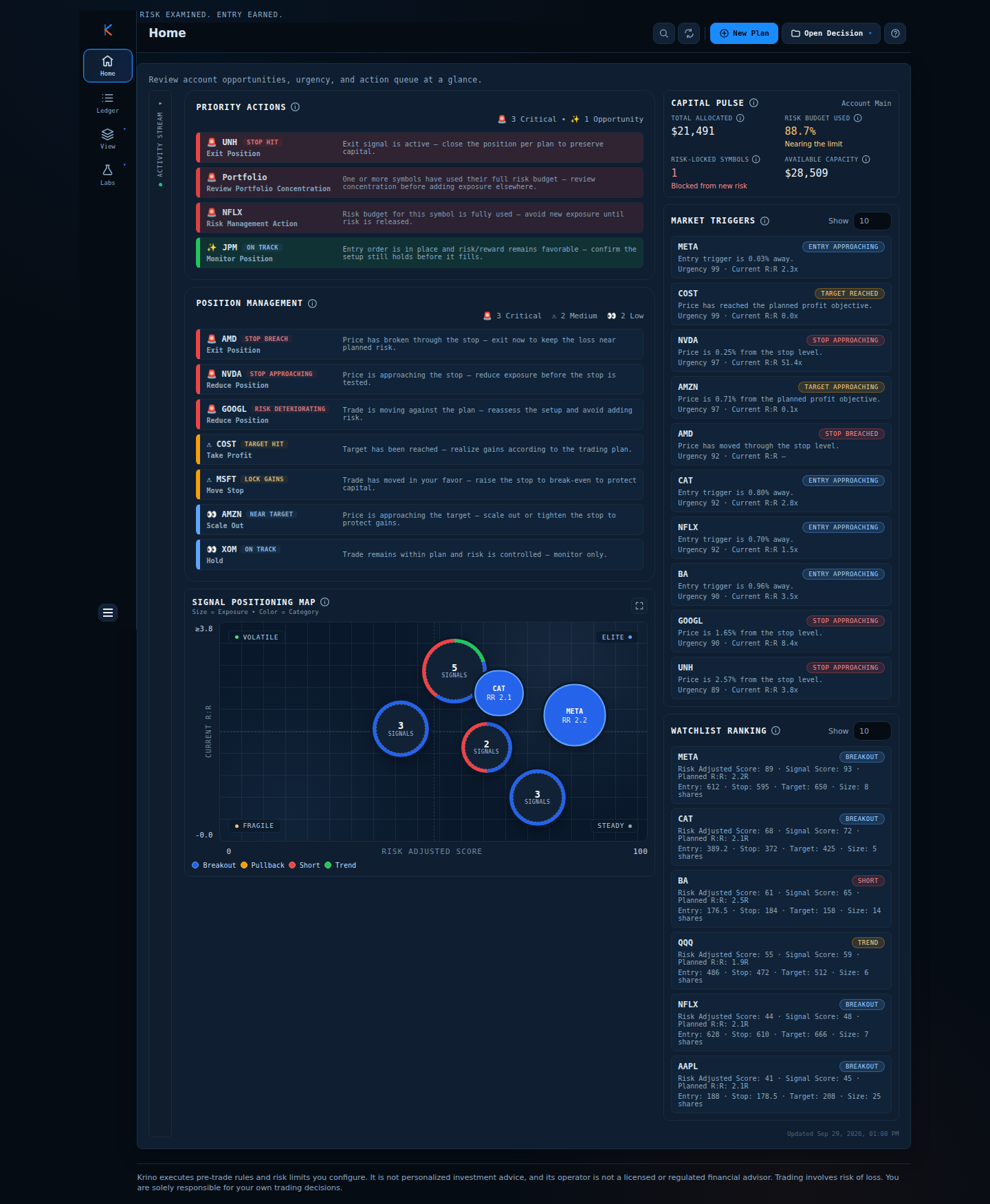
Watchlist Ranking on Home lists non-executing setups ordered by risk-adjusted score (the average of the technical and the risk score), then signal score, then expected reward-to-risk. Accepted and executing trades are excluded: they are positions, managed elsewhere.
Each row shows the setup type and the plan’s entry, stop, target and size, so the ranking and the trade it implies stay together. You choose how many entries to show.
See a long list become a short one.
The demo home screen has Watchlist Ranking for sample symbols, with entry, stop and size for each. No signup, no email, no card.
Quick start checklist
- Keep candidate setups separate from open positions.
- Rank by a score that already accounts for risk.
- Use signal strength and reward-to-risk as tie-breakers.
- Limit yourself to the number of trades your budget allows.
- Note why each skipped idea was skipped.
The question that actually matters
Instead of asking “which signal looks the strongest?” ask “which setup is best after I account for risk?” Re-rank your watchlist tonight on that basis and compare the top three with the ones you'd have picked by instinct.
Rank your next setups the same way.
See the ranking on sample symbols, then open the top one. No signup needed.
Krino executes rules and risk limits you configure. It is not personalized investment advice. Trading involves risk of loss. You are solely responsible for your own trading decisions. The worked examples in this article use illustrative prices and demo data, not a recommendation or real market data.