How to review a losing trade: bad luck or broken rules?
A loss tells you nothing by itself. The review has to separate a trade that was wrong from a process that was wrong. Here is a five-step review you can finish in ten minutes.
Most trade reviews end with a feeling: “That was a bad trade.” “I should have waited.” “The market was against me.” Those describe the outcome, which is mostly noise.
A useful review asks specific questions in order and ends with one of two verdicts: bad luck, good process or rule break. Each has a different next action.
The problem: outcome bias
We judge decisions by results, so sloppy trades that work get repeated and disciplined trades that stop out get abandoned. Over a hundred trades that is backwards.
A proper review needs the plan as it was before the trade. Memory rewrites stops and reasons to match the result.
Key concept: compare the trade to its plan, not to the result
The plan is the control. Measure and price the gap between plan and outcome. Zero gap and a loss means bad luck. A large gap is the lesson.
A loss that followed the plan is the cost of doing business. A loss that did not follow the plan is a mistake, and mistakes can be fixed.
Worked example: a stopped-out DIS trade
- Plan: buy 30 shares at 112.60, stop 106.90, target 126. Reward-to-risk 2.35. Confidence 59%, with drawdown flagged as a fragile edge.
- Check 1, the decision: the plan existed before the trade and met the 2.0 minimum. No rule broken here.
- Check 2, the execution: Sep 10 buy 30 at the planned 112.60 in one fill. Sep 20 sell 30 at the planned stop, 106.90. Entered and exited as planned.
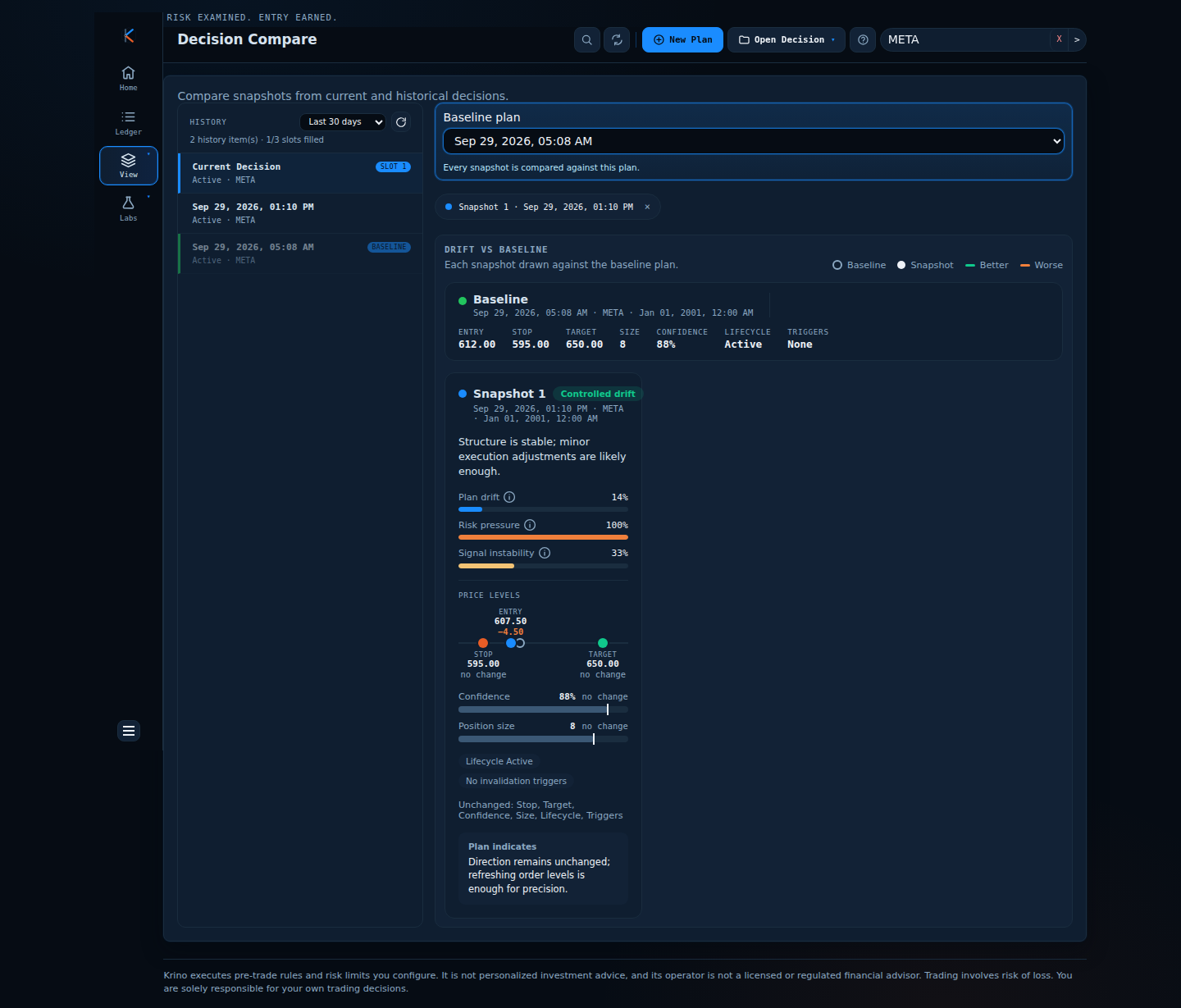
- Check 3, the drift: compare the snapshot at close with the snapshot at decision time. Plan drift: 0%. Entry, stop, target and size are unchanged, so the stop was never moved.
- Check 4, the cost of hesitating: exiting at the stop lost 171. Hesitating to 104 would have lost 258. Taking the stop on time saved 87.
- Verdict: bad luck, good process. Nothing to change in the rules, except possibly watching names flagged as fragile edge.
Post-mortem on a losing trade
From the ledger loss back to the original decision, the execution sequence, the drift check and a what-if on the cost of hesitating.
Illustrative prices and staged data; captions are added to the recording.
Comparison: two losing trades, two verdicts
| Question | Trade A (DIS) | Trade B (hypothetical) |
|---|---|---|
| Was there a plan before entry? | Yes | No, written after |
| Filled at the planned price? | Yes | Chased 2% above |
| Stop moved? | No | Widened twice |
| Loss vs planned risk | 1.0× | 2.1× |
| Verdict | Bad luck, good process | Rule break |
| Next step | Nothing; keep the rules | Tighten a rule, e.g. raise the minimum R:R |
Common mistakes
- Reviewing only losers. Winning trades can contain rule breaks too, and they are the ones you will repeat.
- Reviewing from memory. Use the saved plan, not the story you tell about it.
- Changing the rules after one loss. One trade is not evidence. Look for patterns across ten.
- Skipping the price of the mistake. “I entered late” is vague. “I entered 2% late, which cost 0.4R” is actionable.
A framework you can use tomorrow
- Pull the plan. Entry, stop, target, size, reason, as written before the trade.
- Check execution. Fill prices, times and partial fills against the plan.
- Check drift. Was anything changed after entry, and when?
- Price the gap. Express every deviation in currency or R.
- Choose a verdict. Bad luck, good process, or rule break. If rule break, name the one rule to tighten.
How Krino helps
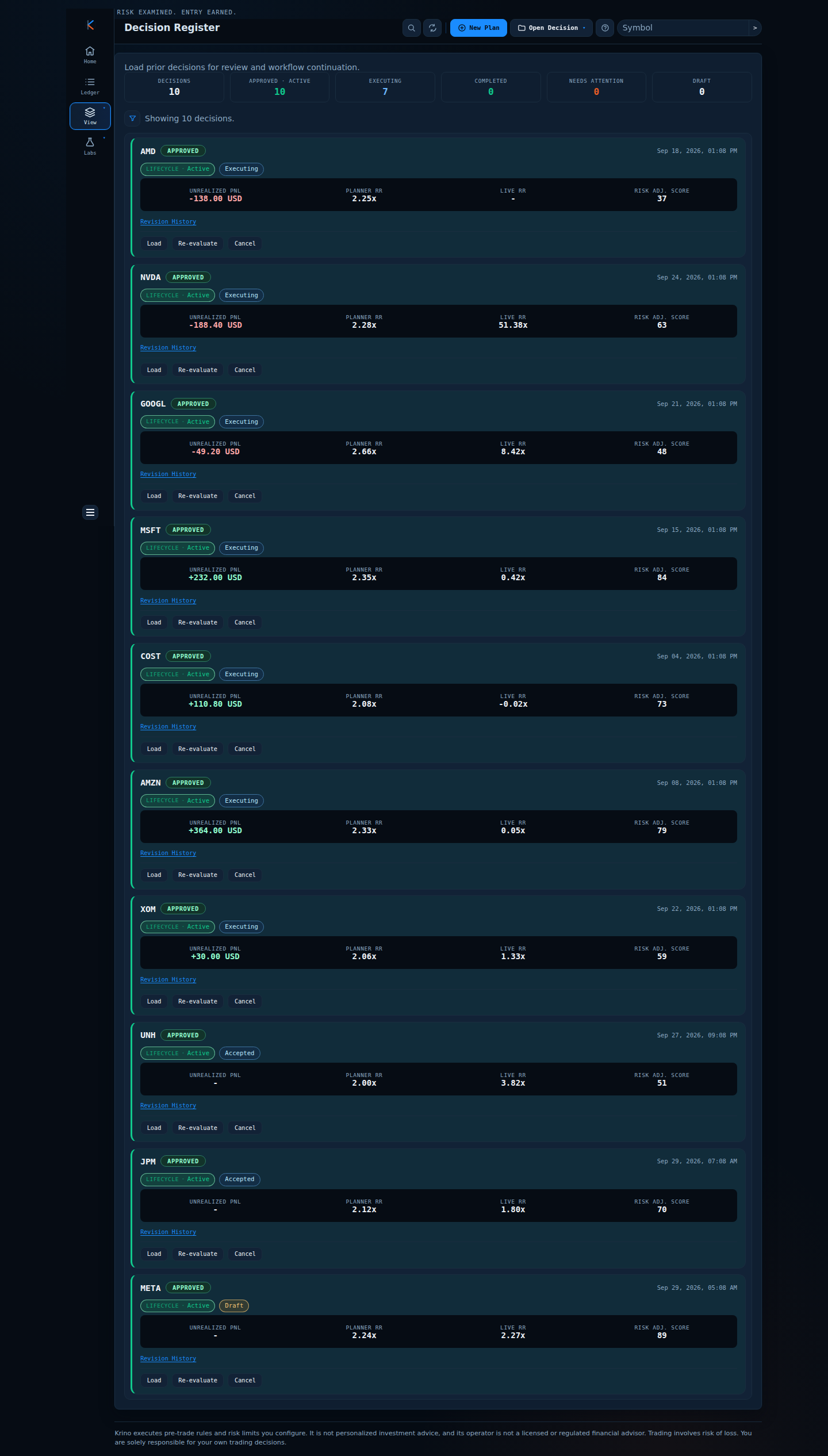
Every Krino decision is saved with its levels, reasons and confidence, and each revision is kept. The Ledger links transactions to decisions, so a realised loss opens straight onto the plan behind it. The Execution Journal shows what happened and when, and Decision Compare shows how far a later snapshot has drifted from the original, level by level.
What-If lets you replay the exit at the planned stop or at a worse price to price the cost of hesitating. The review rests on saved facts, not memory.
Review a trade against its plan.
The demo has sample decisions, approved, completed and cancelled, each with its reasons and revision history. No signup, no email, no card.
Quick start checklist
- Save every plan before entering, not after.
- Review a trade within 24 hours of closing it.
- Check fills, drift and stop changes before judging the outcome.
- Price each deviation in currency or R.
- End each review with one verdict and at most one rule change.
- Review winners as well as losers.
The question that actually matters
Instead of asking “why did I lose?” ask “did I follow the plan, and was the plan any good?” Run the five steps on your last losing trade. It takes ten minutes and tells you more than a month of gut feeling.
Review your next loss against the plan.
See how a recorded plan turns a review into a comparison. No signup needed.
Krino executes rules and risk limits you configure. It is not personalized investment advice. Trading involves risk of loss. You are solely responsible for your own trading decisions. The worked examples in this article use illustrative prices and demo data, not a recommendation or real market data.