The attention radar: which symbol needs you first?
Not every alert is equal. An attention radar ranks the symbols that need a decision now, by how close price is to a trigger and how much it matters if it is hit.
A trading day raises two questions. “What should I consider?” is about quality and can wait. “What needs me right now?” is about urgency and cannot.
Most tools answer only the first. An attention radar answers the second, ranking symbols by how soon a decision is due, not by how good the idea looks.
The problem: quality and urgency get mixed up
A trader sorts the watchlist by “best setup” and starts at the top. Meanwhile a position three rows down has just broken its stop.
The fix is separate lists for separate questions: a quality ranking for new ideas, and an urgency ranking for anything close to a level that forces a decision.
Key concept: urgency is distance plus consequence
An urgency score combines how close price is to a trigger with how much the trigger matters. In Krino it is a 0–100 number built from:
| Distance | Closer trigger, higher score |
| Lifecycle and execution state | Accepted or executing trades get a strong boost: money is at work |
| Confidence | A small contribution from the plan’s confidence |
| Freshness | Recent updates score higher than stale ones |
| Data quality | Missing prices cap the score conservatively |
Urgency answers “what must I look at now?” Quality answers “what should I consider?” Keep the two lists separate and read them in that order.
Worked example: triage by trigger type
| Badge | Meaning | Typical response |
|---|---|---|
| Stop breached | Price has moved through the stop | Exit per plan |
| Target reached | Price is at the profit objective | Take profit as planned |
| Stop approaching | Price is within a small % of the stop | Reduce or tighten before it is tested |
| Target approaching | Price is near the objective | Scale out or raise the stop |
| Entry approaching | A waiting setup is about to trigger | Confirm the plan still holds |
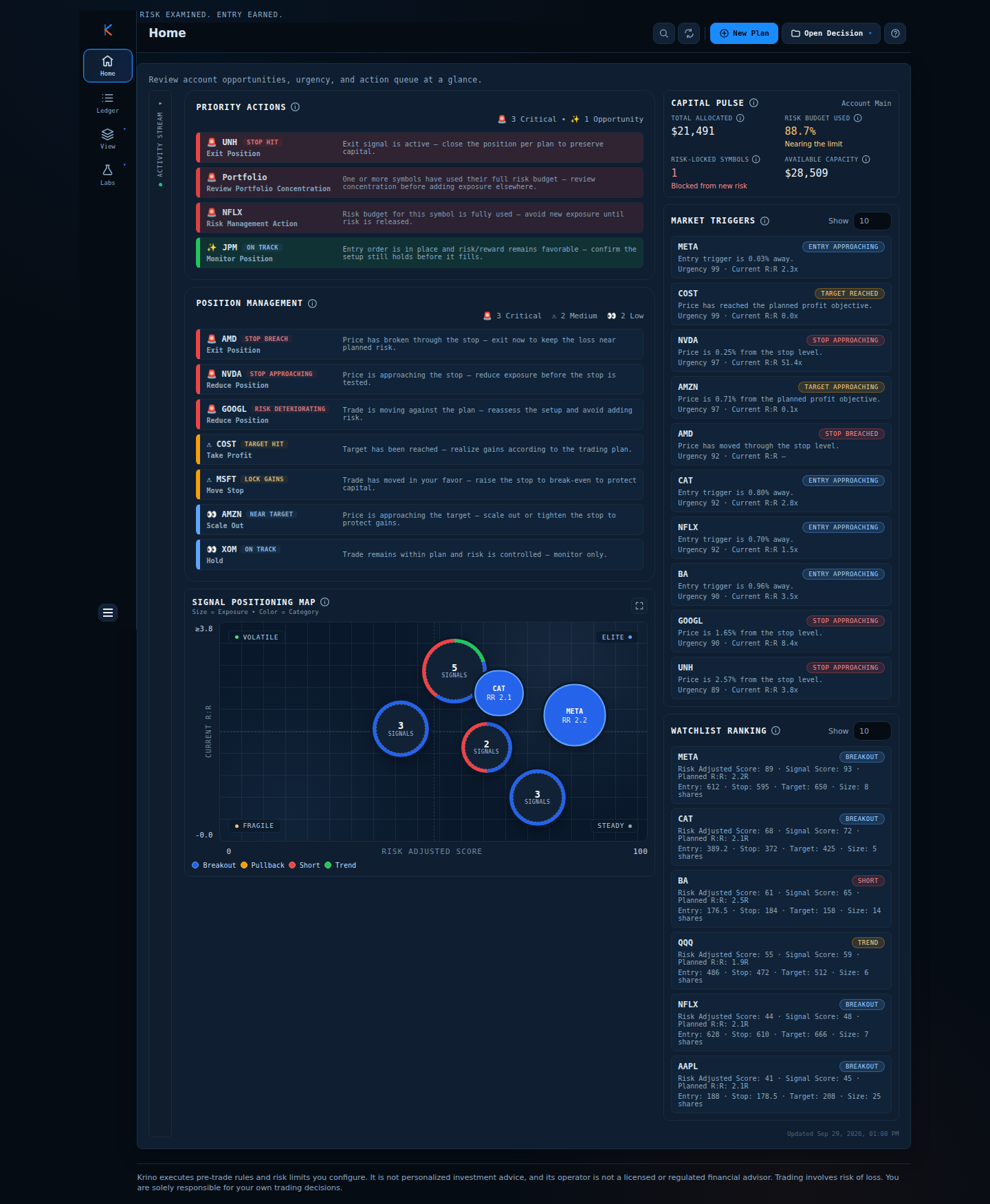
- Situation: the radar shows META (entry approaching, 0.03% away, urgency 99), COST (target reached, urgency 99), NVDA (stop approaching, 0.25%, urgency 97) and AMD (stop breached, urgency 92).
- Decision: a higher score does not mean “more important”. A stop breach at 92 still means money is at risk now. Handle breaches and reached targets, then approaching stops, then entries.
- Outcome: loss-containing and profit-protecting decisions come before new entries, even when a new entry has a higher number.
Comparison: radar vs watchlist ranking
| Attention radar | Watchlist ranking | |
|---|---|---|
| Question | What needs attention first? | What are my best setups to consider? |
| Built from | Watchlist symbols plus latest decision | Decisions that are not yet accepted or executing |
| Ranks by | Urgency: distance to trigger, state, freshness | Risk-adjusted score, then signal, then reward-to-risk |
| Includes open trades? | Yes (stop and target distance) | No |
| Includes symbols with no plan? | Yes, at zero | No |
Common mistakes
- Treating the radar as a buy list. Near an entry means look, not act. The plan must still hold.
- Ignoring stops because the number is lower. Always read the badge, not just the score.
- Never clearing stale triggers. Symbols with old plans clutter the top and teach you to ignore it.
- Using only one list. Urgency without quality chases noise, and quality without urgency misses breaches.
A framework you can use tomorrow
- Start the day with the urgency list, not the idea list.
- Handle anything breached or reached first.
- Then stops approaching, then targets approaching.
- Only then look at entries, and confirm each plan still holds at the current price.
- After that, open the quality ranking for new ideas.
How Krino helps
The radar is built from your watchlist and each symbol’s latest decision, so it follows the same rules as the rest of the app. Rows show the trigger, the distance, the urgency score and the current reward-to-risk, and a row opens its decision when one exists. The top rows are ranked by urgency, then by distance, then by confidence, then by recency.
Explanations name the action to take (for example, reduce exposure before the stop is tested), not just the level.
See which symbol needs you first.
The demo home screen has sample positions, triggers and priorities already loaded. No signup, no email, no card.
Quick start checklist
- Open the urgency list first, every session.
- Read the badge before the number.
- Breaches and reached targets before anything else.
- Treat entry-approaching as “confirm the plan”.
- Retire or refresh stale plans.
- Use the quality list only after the urgent items are handled.
The question that actually matters
Instead of asking “what is the best trade today?” ask “what is the most urgent decision on my account?” Clear the urgent list before you look for ideas.
Start tomorrow with the one symbol that matters.
Open the demo and see the ranked list a real portfolio produces. No signup needed.
Krino executes rules and risk limits you configure. It is not personalized investment advice. Trading involves risk of loss. You are solely responsible for your own trading decisions. The worked examples in this article use illustrative prices and demo data, not a recommendation or real market data.