You don’t lose money on bad picks. You lose it on broken rules.
Moving the stop because it “feels wrong”. Sizing up after a win. Holding a loser three weeks too long. A journal shows you these afterwards. Here is how to stop them before the order, and keep the plan so you can see where you broke it.
Most losing streaks are not caused by bad ideas. They come from a good plan that was changed after the trade began: a wider stop, a bigger size, a hope.
You already have rules. The problem is that they are checked by the person least able to enforce them, in the moment they are most tempting to bend. This article shows the three most common breaks, what each costs, and how to catch them before the order instead of in next week’s review.
The problem: three rule breaks that look like judgment
None of these feels like breaking a rule at the time. Each feels like a reasonable call, which is why they repeat.
| Rule break | What it tells you | What it costs |
|---|---|---|
| Moving the stop | “It needs room.” | A known loss becomes an unknown one |
| Sizing up after a win | “I’m in rhythm.” | More risk on a streak that proves nothing |
| Holding a loser | “It will come back.” | A 1R loss grows to 2R or worse |
Key concept: a rule only counts if it is checked before the order
A journal records a break after it has cost you. A rule at the gate records the plan first, checks it against your limits, and refuses what does not fit. Then any later change is a visible difference from a plan that was saved earlier, not a story you tell yourself.
Two things make a rule real: something checks it before the order, and the original plan is kept unedited. Without the second, every review compares the trade to a memory.
Worked example: the same META plan, three temptations
- The plan: buy 8 shares at 612, stop 595, target 650. Risk 136, reward 304, reward:risk 2.24. Your minimum is 2.0.
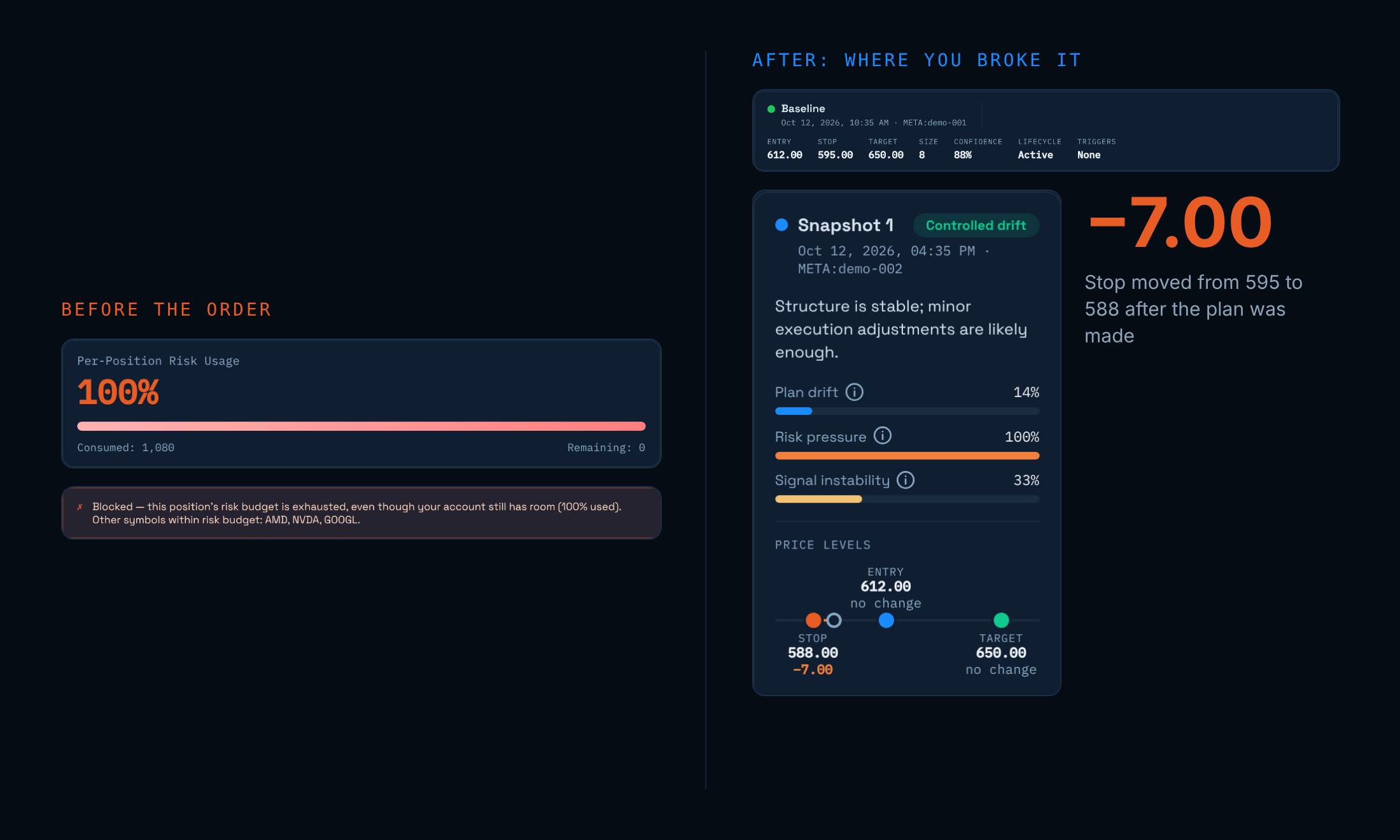
- Moving the stop: the price dips and the stop moves to 588 “to give it room”. Risk per share rises from 17 to 24, so risk goes from 136 to 192 (41% more) and reward:risk falls to 1.58, below your 2.0 minimum. Decision Compare shows the stop at 588.00, −7.00 against the saved plan.
- Sizing up after a win: the next trade feels safe, so you add shares. Size should follow the stop and your risk limit, not your mood. When a symbol’s risk budget is used up, the demo blocks the plan: “this position’s risk budget is exhausted, even though your account still has room.”
- Holding a loser: AMD is bought at 162 with a stop at 154, and trades at 152.8. The loss is already about 1.2R. Home flags it as a breached stop with the action Exit Position: “exit now to contain it”.
- Outcome: each break is either blocked at the gate or visible as a number against a plan you saved earlier.
See a locked plan and a drifted plan.
The demo opens a plan blocked by its risk budget, and a META plan with a widened stop. No signup, no email, no card.
Comparison: a journal vs a rule at the gate
| Question | Journal review | Rule at the gate |
|---|---|---|
| When does it act? | After the loss | Before the order |
| Who enforces it? | You, later | The check, every time |
| Is the original plan kept? | Often rewritten from memory | Saved and versioned, never edited |
| Can you price the break? | Roughly | Exactly, level by level |
Common mistakes
- Writing the plan after the entry. It will agree with whatever you did.
- Editing the plan instead of versioning it. Save a new version and keep the old one.
- Limits in percentages you must compute under stress. Write them as currency amounts.
- An override for every rule. A limit you can switch off in one click is a suggestion.
- Reviewing only losers. A winner with a moved stop is still a moved stop.
A framework you can use tomorrow
- Write three limits: risk per trade, risk per symbol and a minimum reward:risk.
- Plan before the order: entry, stop, target and size, with a timestamp.
- Check the plan against the limits. If it fails, it does not become an order.
- Freeze it. Any change is a new, dated version.
- Review the gap weekly: price each difference in R and fix the costliest habit.
How Krino helps
Krino applies your limits to every plan before it can be accepted. A plan below your minimum reward:risk is flagged, and a symbol or account over its risk budget is locked until risk is freed. Sizing comes from the stop distance and your risk limit.
Every decision is saved with its levels and each re-evaluation is kept as a new version. Decision Compare then shows the difference between any two, level by level. Krino does not connect to your broker, so it cannot stop an order you place elsewhere; it gives you the gate and the record to hold yourself to.
Quick start checklist
- Write risk per trade, risk per symbol and a minimum reward:risk in currency.
- Write the plan, with a timestamp, before the order.
- Let the check refuse any plan that breaks a limit.
- Never edit a live plan; save a new version.
- Price every deviation in R at the weekly review.
The question that actually matters
Instead of asking “was this a good pick?” ask “did I trade the plan I wrote?” Take your last three trades and compare each fill and stop with the plan you made before entering.
Find where your plan drifted.
Open Decision Compare on the META plan and see the stop move from 595 to 588. No signup needed.
Krino executes rules and risk limits you configure. It is not personalized investment advice. Trading involves risk of loss. You are solely responsible for your own trading decisions. The worked examples in this article use illustrative prices and demo data, not a recommendation or real market data.