Why most traders ignore risk, and what to do instead.
Everyone agrees risk management matters. Almost nobody does it when it counts. The reasons are mostly psychological, and the fix is mostly structural.
Every trader can recite the rules: risk 1% per trade, use a stop, don't average down. Then a great-looking setup appears on the third losing day, and the rules feel like suggestions.
Ignoring risk is rarely ignorance. It is a predictable response to loss, excitement and boredom. This article shows why rules fail under pressure and how to build a structure where pressure doesn't get a vote.
The problem: risk limits fail at the worst moment
Consider a trader with a 1% rule and an account of 25,000. After two small losses they are 0.8% down on the week and annoyed. A clean breakout appears. “This one is different, I will size up a bit to get back to even.”
The logic feels reasonable in the moment, which is the problem: the rule was written calm and is being judged under stress. The most dangerous trades are the ones taken to recover the last loss.
Key concept: pre-commitment
Willpower is a poor risk manager; structure is better. Decide the limits before the trade, in writing, and have something check them at the moment of the trade.
A useful budget has three layers, each catching a different failure:
| Per trade | The most you can lose on this one idea |
| Per symbol | Total open risk on one name, including adds |
| Per account | Total open risk across everything at once |
Risk limits only work if they are checked before the order, by something that does not get tired, hopeful or angry.
Worked example: a good setup, no room left
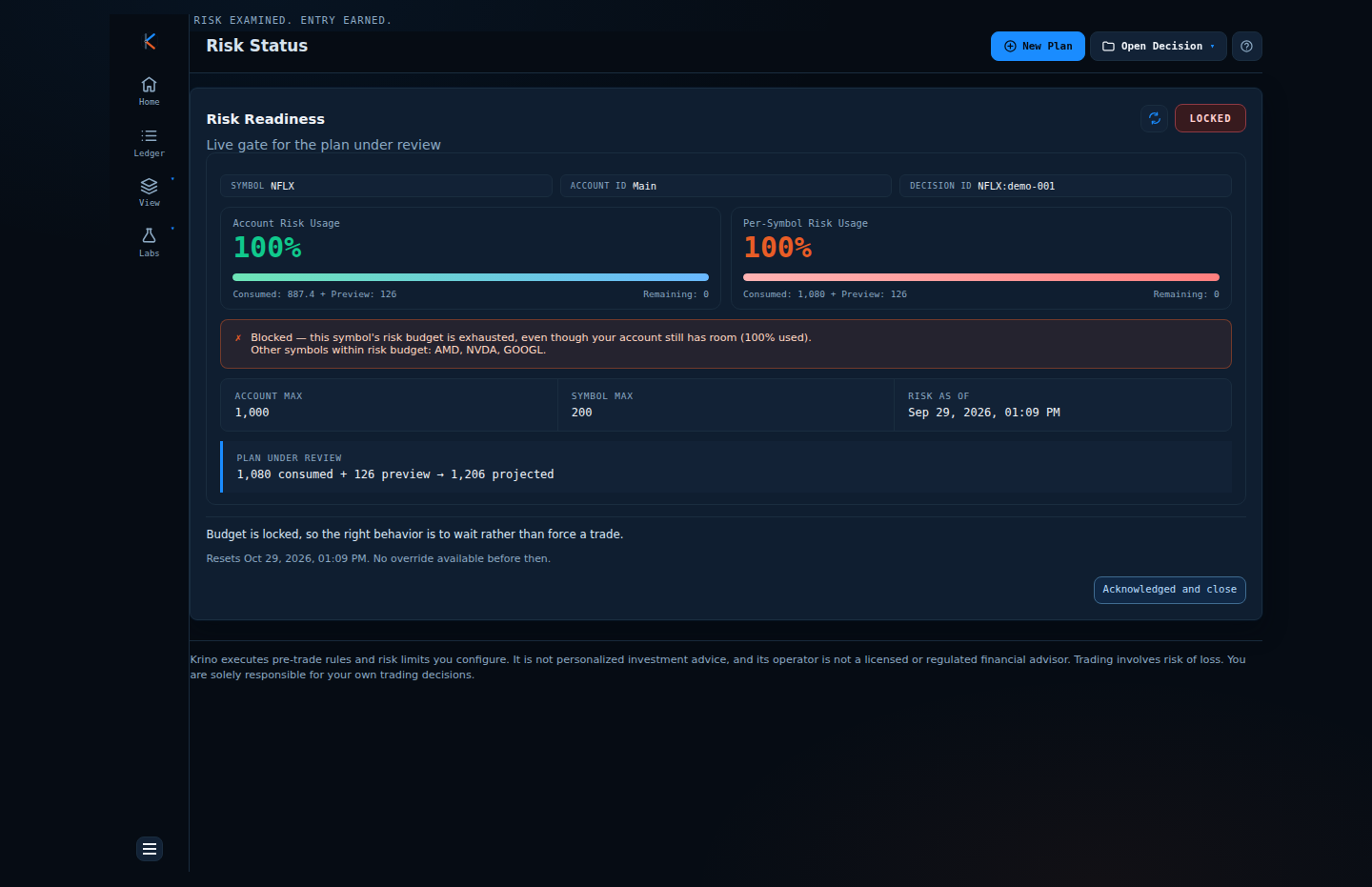
- Situation: account risk limit 1,000, per-symbol limit 200. NFLX already carries its full 200 through open plans, while the account as a whole still has room. A new NFLX plan would add 126 more.
- Decision: the symbol’s budget is gone, so the plan is blocked even though the account has room.
- Outcome: the answer is no, however good the setup looks. Wait until risk frees up: open plans complete, are rejected or are cancelled.
Comparison: how traders handle risk
| Approach | How it works | Where it breaks |
|---|---|---|
| Gut feeling | “That feels like a small position” | Feelings scale with confidence, not with risk |
| A rule in your notes | “Risk 1% per trade” | Nobody checks it at 15:55 on a bad day |
| Calculator before each trade | Compute size from stop distance | Covers one trade, not the whole book |
| Budgeted, checked limits | Per-trade, per-symbol and per-account budget evaluated before the order | Needs setup, and discipline not to override |
Common mistakes
- Counting only the new trade. Five “small” positions in the same theme are one large position. Measure total open risk.
- Adding to a position without re-checking risk. Adds are where risk quietly builds. Treat each add as its own plan.
- Sizing up to recover losses. It raises risk exactly when judgment is weakest.
- Moving the stop. It converts a known loss into an unknown one.
- Having an override for everything. A limit you can switch off in one click is not a limit.
A framework you can use tomorrow
- Pick the three numbers: risk per trade, per symbol and per account.
- Convert them to currency amounts, not percentages you have to compute under stress.
- Before each order, write the new total open risk next to the limit.
- If the total is over, the trade does not happen today. No exceptions, no resizing to squeeze it in.
- On a lock, review and prepare plans instead of forcing orders.
How Krino helps
Krino evaluates every plan against your risk budget before it can be accepted. Risk Status shows what is consumed, what the new plan would add and what remains, for the account and for the symbol separately. When a limit is reached the status is Locked and the guidance is to wait, not to override.
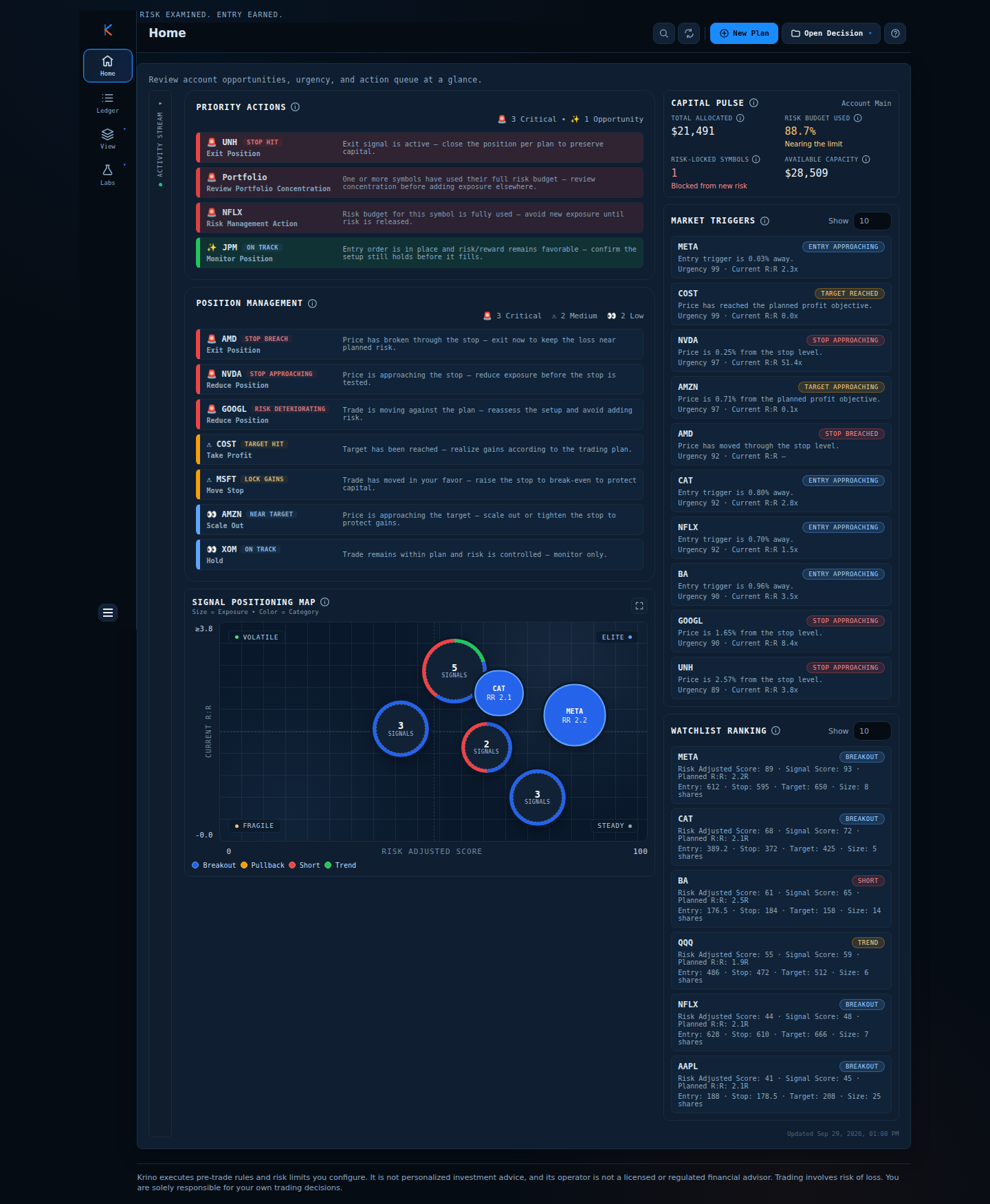
Home surfaces it as well: Capital Pulse shows how much of the budget is used and how many symbols are locked, and Priority Actions stops pushing new entries when the account has no room.
What does a losing streak cost?
See a limit that holds when you would not.
The demo opens Risk Status for NFLX: its risk budget is used up, so new plans are blocked until it resets. No signup, no email, no card.
Quick start checklist
- Write down three limits in currency: per trade, per symbol, per account.
- Check total open risk, not just the new trade, before every order.
- Treat adds to a position as new plans with their own risk.
- Never resize a rejected trade to “make it fit”.
- Remove one-click overrides from your process.
- Review risk usage every evening, not only when you trade.
The question that actually matters
Instead of asking “how much can I make on this trade?” ask “how much total risk will I be carrying after it?” Write down the three limits today and have something other than your mood check them.
Make your next limit a gate, not a hope.
Set the limit once and let it say no for you. Try it on sample trades, no signup needed.
Krino executes rules and risk limits you configure. It is not personalized investment advice. Trading involves risk of loss. You are solely responsible for your own trading decisions. The worked examples in this article use illustrative prices and demo data, not a recommendation or real market data.