What makes a trading journal useful? Write the plan down before the trade.
Entry, exit and P&L tell you what happened. They don't tell you which of your habits keeps costing you money. For that, the journal needs one thing most journals skip: a record made before the outcome was known.
Traders keep a journal to find repeating mistakes: revenge trades, moved stops, late entries, ignored levels, broken setup rules, overtrading, sloppy risk.
So they add mistake tags and review them at the weekend, but patterns rarely emerge. The problem isn't the tags; it's what they're checked against.
This guide shows how to make mistake tracking measurable instead of opinion-based, with a worked example and a five-step routine for your next trade.
Prefer to watch? See a 2-minute review of one trade in Krino
The problem: tagging after the fact
A mistake is a gap between what you meant to do and what you did. If "what you meant to do" only exists in your head, every review compares the trade against a memory, and that memory has already seen the outcome.
A moved stop becomes "giving it room" if the trade recovers and "bad luck" if it doesn't. The same action gets tagged by its outcome.
A mistake tag is only as trustworthy as the plan it's checked against. If the plan was written after the entry, or edited since, the tag measures hindsight, not discipline.
Every common mistake is a measurable gap
Once the plan exists before the order, most mistakes stop being judgment calls. Each is a difference between two recorded facts:
| Mistake | Write down before entry | Check after the trade |
|---|---|---|
| Entering late | Planned entry price | Fill vs. planned entry, in R |
| Moving stops | Planned stop | Final stop vs. planned stop; was the loss bigger than 1R? |
| Ignoring key levels | The levels the plan is built on | Did entry and stop respect them? |
| Breaking a setup rule | The rules that must be true | Was the trade taken with a rule unmet? |
| Revenge trade | Time the plan was made | Plan made minutes after a stop-out, or no plan at all |
| Overtrading | Daily trade cap or risk budget | Trades without a plan; budget exceeded |
| Poor risk management | Planned money at risk (1R) | Realized loss in R |
R is the amount you planned to risk on the trade. Measuring every deviation in R makes a late entry on a $20 stock and on a $600 stock comparable.
Worked example: one trade, two mistakes
The plan, written before the order:
| Entry | 612.00 |
| Stop-loss | 595.00 |
| Take-profit | 650.00 |
| Quantity | 8 shares |
| Risk per share (612 − 595) | 17.00 |
| Planned risk, 1R (17 × 8) | 136.00 |
What actually happened:
- Situation: the price ran before the order went in. The trader chased and filled at 618.
- Decision: the price then dipped toward 600. To "give it room", the stop was moved from 595 to 588.
- Outcome: stopped out at 588. Loss: (618 − 588) × 8 = 240.
Against the written plan, the review needs no interpretation:
| Late entry (618 − 612) / 17 | +0.35R worse |
| Moved stop (595 → 588) | Yes |
| Realized loss 240 / 136 | 1.76R |
Without the plan, the journal says "−240, stopped out". With it, the trade has two priced tags: the loss was 1R by design and 0.76R by behaviour.
What did your behaviour cost, in R?
Four ways to keep a journal
| Approach | Hindsight-proof | Finds patterns | Measures the cost | Effort |
|---|---|---|---|---|
| Notes after the trade | No | Hard | No | Low |
| Mistake tags after the trade | No | Yes | Rarely | Low |
| Plan written before, editable later | Partly | Yes | Partly | Medium |
| Plan locked before entry, compared after | Yes | Yes | Yes, in R | Medium |
"Editable later" is the trap: a plan you can quietly adjust after entry ends up agreeing with whatever you did.
Common journaling mistakes
- Reviewing only losers. A winning trade with a moved stop is still a moved stop. Review every trade against its plan, whatever the outcome.
- Editing the plan after entry. It erases the very gap you're trying to measure. Change the plan by recording a new version, and keep the old one.
- Too many tags. Thirty tags spread the data too thin. Start with the seven above.
- Counting tags instead of costing them. "Moved stop × 6" matters less than "moved stops cost 4.1R this quarter".
- Free text only. Paragraphs are hard to search. Put numbers in fields, and keep notes for the why.
A five-step routine you can start tomorrow
- Plan before the order. Entry, stop, target, size, the one-line reason, and the rules that must be true.
- Timestamp it and freeze it. Any change becomes a new, dated version. Nothing gets overwritten.
- Record fills against the plan. Every buy and sell is linked to the plan it executes.
- Derive the mistakes from the gap. Use the mistake map above, and express each deviation in R.
- Review weekly. Rank the tags by total R lost, and pick one habit to fix next week.
What this looks like in Krino
Krino is built around steps 1 and 2: a plan made, checked and timestamped before you act. The video shows one trade's week reviewed against its plan.
One week of one trade, reviewed against its plan
A CRM plan is written before the open: entry 250, stop 241, 20 shares, 180 at risk. The review then checks the week against it, one screen at a time.
- Entered lateFilled at 254.60, 4.60 above the plan.
- Moved the stopA new plan, dated after the fill, widened it from 241 to 236.
- Revenge tradeA bigger position 29 minutes after the stop-out, with no plan behind it.
- Poor riskThe planned trade lost 372: 2.1× the 180 the plan allowed.
Illustrative prices on a staged week. The mistake captions are added for the video and read off the screens.
You just watched the review. Now click through it yourself.
The demo has the plan, the checklist, the revision history and Decision Compare from this article, with sample data. It opens in your browser — no signup, no email, no card.
The same routine, screen by screen:
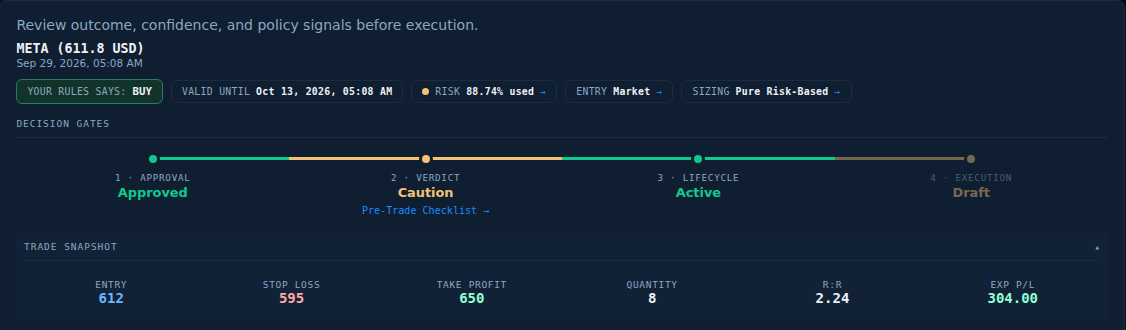
The plan, with its timestamp
Decision Readiness shows the plan your rules produced: entry, stop, target, quantity, R:R and expected P/L. It's stamped with the time it was made, along with the risk budget it uses and the entry and sizing strategy applied.
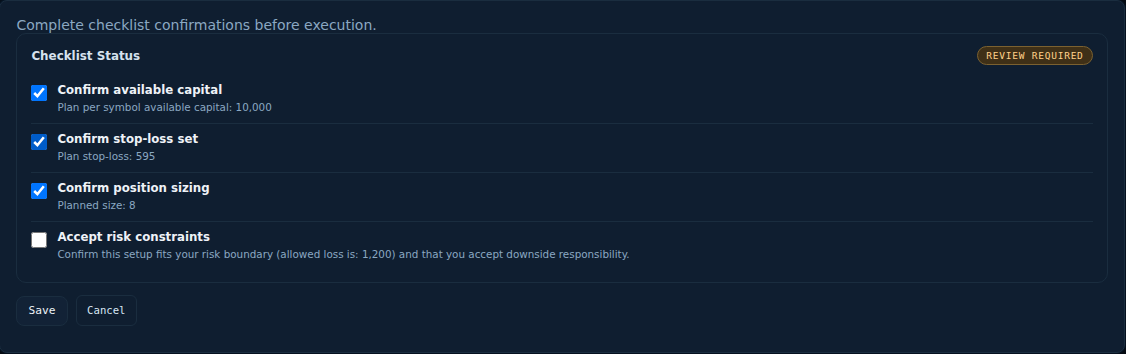
Your rules, confirmed before execution
The Pre-Trade Checklist asks you to confirm capital, stop-loss, size and the risk boundary before the plan can move to execution. It turns "breaking a setup rule" into a recorded yes or no.
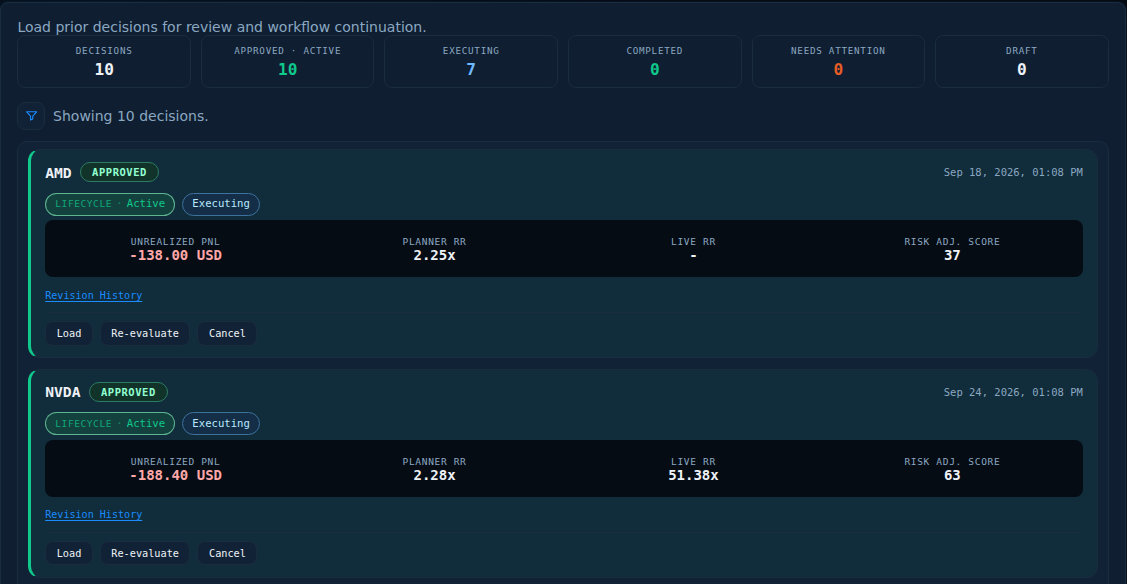
Plans aren't edited, they're versioned
Every decision is stored as an append-only history. Re-evaluating a plan adds a new revision. The earlier one stays in the Decision Register's revision history, read-only. Once a plan is accepted, its entry and sizing strategy are locked.
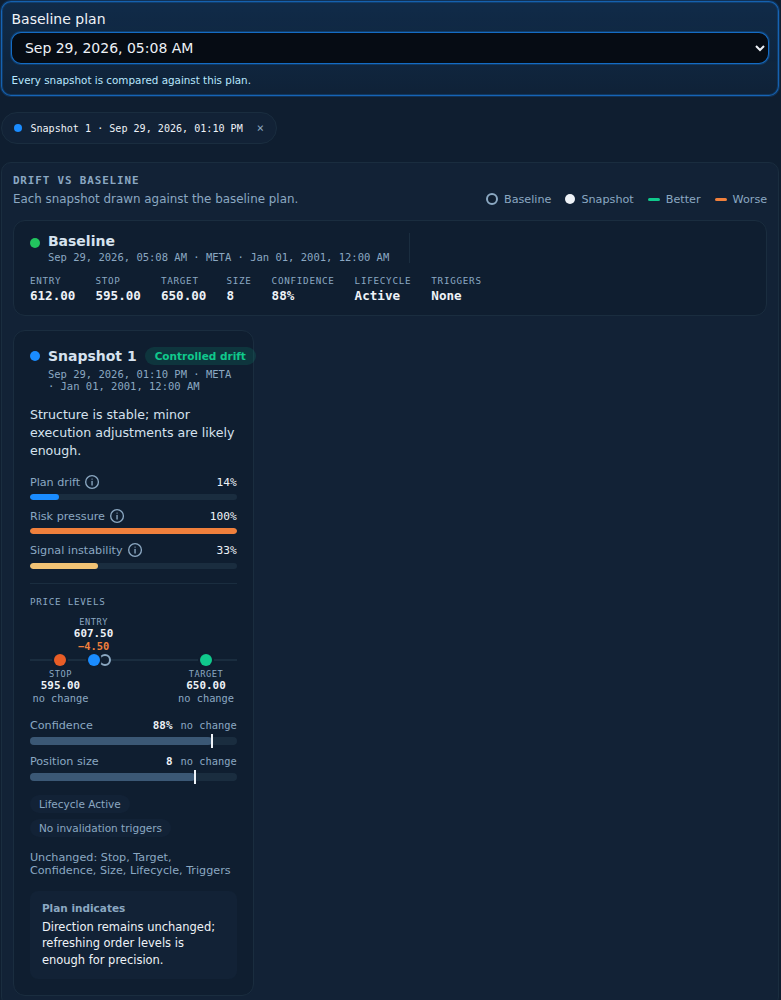
See exactly what moved
Decision Compare sets any later snapshot against the original plan. Entry, stop, target, size and confidence are each marked as changed or unchanged. A moved stop shows up here as a number, not a memory.
Krino doesn't tag your mistakes for you. It keeps the record made before the trade, so the tags you add, in Krino or elsewhere, are checked against something that can't change afterwards.
Quick start checklist
- Write entry, stop, target and size before placing the order.
- Note the time the plan was made.
- Write the one rule that must be true for the trade to exist.
- Never edit a live plan. Save a new version instead.
- After the trade, record the fill and the final stop.
- Express every deviation in R.
- Tag with at most the seven mistakes above.
- Each week, find the tag that cost the most R and work on that one.
The question that actually matters
Not "what mistakes did I make?" Asked after the outcome, that question gets answered by the outcome.
The better question: "Where did I depart from what I wrote down beforehand, and what did it cost in R?"
Start with your next trade: write the plan before the order, freeze it, compare afterwards. A few weeks of that shows your patterns more clearly than a year of after-the-fact tags.
Start with your next trade.
Plan it in the demo first: your entry and stop, Krino works out the size and keeps a timestamped record. No signup needed.
Krino executes rules and risk limits you configure. It is not personalized investment advice. Trading involves risk of loss. You are solely responsible for your own trading decisions. The worked example in this article uses illustrative figures; screenshots show Krino's demo mode.